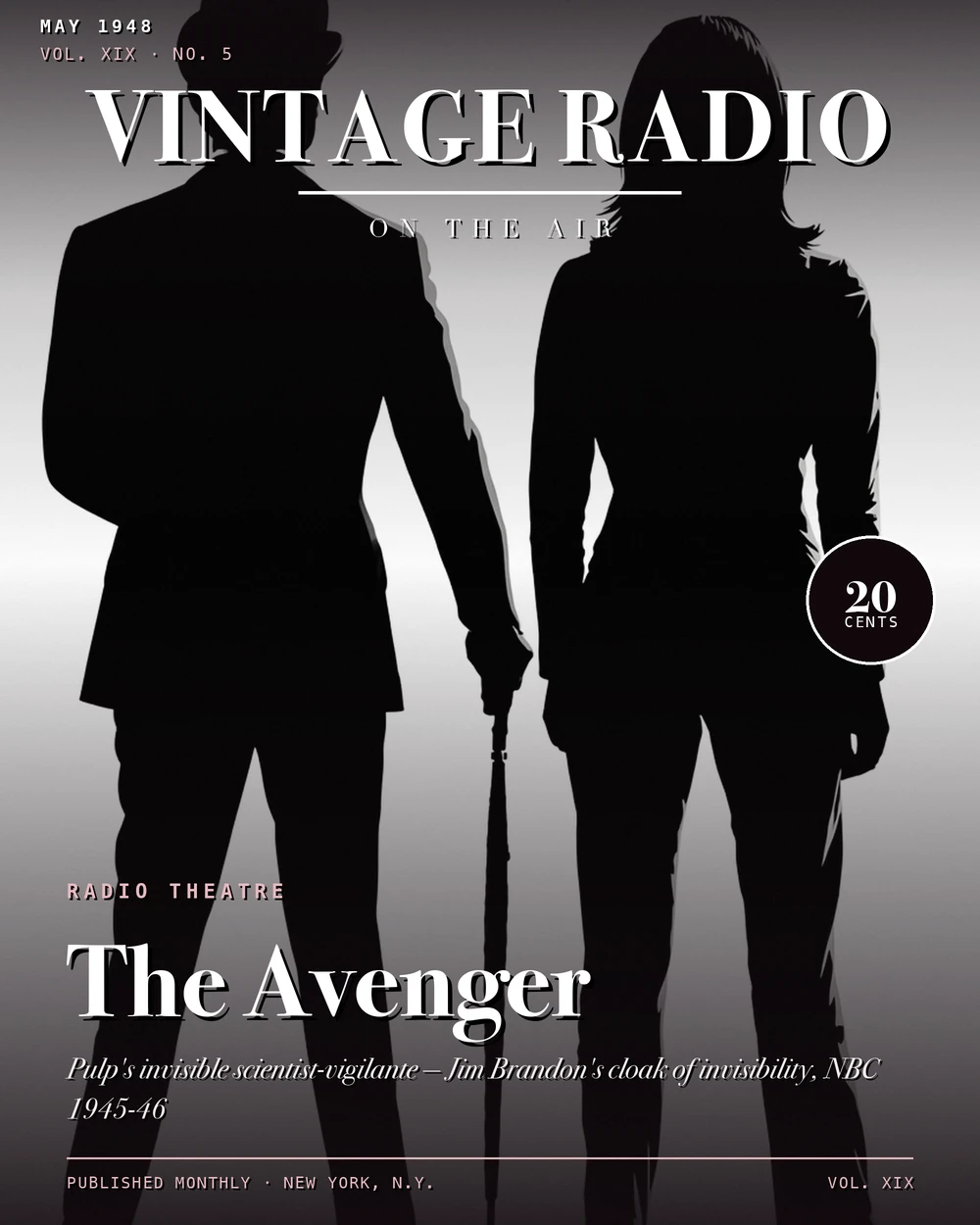
The Avenger
Two Shows, One Name
The Avenger had two distinct lives on radio, and they shared little beyond the title. The first version aired on WHN in New York starting July 18, 1941, and ran until November 3, 1942 — though Golden Age historian Karl Schadow has argued the broadcasts actually continued into roughly June 1943, longer than most sources record. It featured Richard Henry Benson, a super-strong crimefighter adapted from Paul Ernst's pulp stories in The Avenger magazine, a Street & Smith title. Ernst wrote the radio scripts under the house pseudonym Kenneth Robeson, with Street & Smith circulation manager Henry Ralston contributing plotlines. Maurice Joachim directed. The half-hour show aired Fridays at 9 through mid-1941, then moved to Tuesdays at 9:30, shifting again to 9:00 in December.
The lead role passed through at least three actors. The original Benson was an unidentified New York actor whose name has never surfaced; Variety reported in September 1942 that Bill Zuckert had joined the cast without specifying his role; and in the spring of 1943, Vinton Hayworth — a prolific character actor who would later co-found AFRA and serve as its president, and who happened to be Rita Hayworth's uncle — assumed the part. Humphrey Davis played the sidekick, Fergus "Mac" MacMurdie.
How WHN Got It on the Air
The Avenger was the first program WHN ever syndicated. Its in-house Transcription Service had previously distributed only commercials, and the trade publication Broadcasting reported in September 1941 that the station had chosen The Avenger as its inaugural series. Street & Smith handed the scripts over for free, betting that the radio broadcasts would drive pulp magazine sales — and in August 1941, large red cardboard posters appeared on newsstands in the WHN listening area pitching the magazine-and-radio combination directly to readers.
The economics were peculiar. The series ran for 62 weeks, but according to researcher Doug Ellis, only 26 stories were actually produced; reruns and station pre-emptions filled the rest. A single audio episode is known to survive, "High Speed Death," broadcast in the late fall of 1941 and circulating among collectors for years before reaching wider circulation around 2020. Researchers David Kalb and Brian Hochberg, writing in Blood 'N' Thunder, compared surviving WHN scripts with the pulp originals and concluded the radio versions were loose adaptations with significant omissions — most notably the complete absence of Cole Wilson and of Joshua and Rosabel Newton, the African-American couple central to the magazine cast.
The Second Version and Its Gadgets
The Avenger returned in 1945–46 as a transcribed syndication series — recorded episodes distributed to stations rather than a live network run — that scrapped Richard Henry Benson entirely. In his place came Jim Brandon, described on air as a "famous biochemist." James Monks, a long-time stage and radio actor who later played Mr. Moto for NBC, took the lead in most episodes, with Dick Janaver also voicing the role. Helen Adamson played Fem Collier, Brandon's assistant and the only person who knew his secret identity. George Ansbro announced, and Doc Whipple provided the music.
What set Brandon apart from other radio crimefighters were his inventions. He carried a "telepathic indicator" that picked up random thought flashes, and he could disappear using a "secret diffusion capsule" that wrapped him in what the show called the "black light of invisibility." The gadgetry gave the series a pulpier, near-science-fiction edge that the first version, grounded more in physical strength, never had. The character and premise belonged to Gil and Ruth Braun — Gil had worked the idea out while in the Army, according to a 1946 Billboard item, and sold it after his discharge.
The Shadow's Shadow
Charles Michelson Inc. of New York distributed the transcribed series — the same outfit that handled The Shadow in syndication. Walter B. Gibson, who created The Shadow, wrote all 26 known episodes of the 1945–46 Avenger in collaboration with the Brauns, according to Randy Cox's Walter Gibson bibliography. Broadcasting announced in October 1945 that 52 episodes were available to stations, but researchers today believe only 26 were ever produced — and that all 26 survive. The scripts are held in the Street & Smith archives at Syracuse University.
The connection to The Shadow raises obvious expectations, and by most accounts the series didn't meet them. Radio historian Jim Cox catalogued the structural parallels: a hero with a hidden identity, a beautiful female confidante who alone knew his secret, invisibility through a black light, the ability to read thought flashes. Cox attributed the overlap to Gibson's dual authorship and to both characters' origins in Street & Smith magazines. Whatever Gibson brought to The Shadow over its long run, the transcribed Avenger read as a thinner variation on the same formula, without the atmosphere or the distinctive vocal presence that made Lamont Cranston memorable. The pulp critic Don Hutchison had reached a similar verdict about the magazine character years earlier, calling Benson "simply an unnecessary commodity" who arrived too late to compete with The Shadow and Doc Savage.
The syndicated run premiered October 25, 1945, ended April 18, 1946, and continued to be rerun on stations into the 1950s. As a piece of Crime-Detective radio, The Avenger is a useful illustration of how the pulp-hero format traveled from magazine to airwave — sometimes cleanly, sometimes not.